AnalysisStories Analysis
Japan calls its corner stores national security. Canada lets them close with 12 days' notice
Tokyo and Paris have both invoked security to keep a food retailer out of foreign hands. Ottawa now talks about food the same way, but nothing in its rules notices when a neighbourhood store in Calgary shuts.

By Kevin J.S. Duska Jr.Published
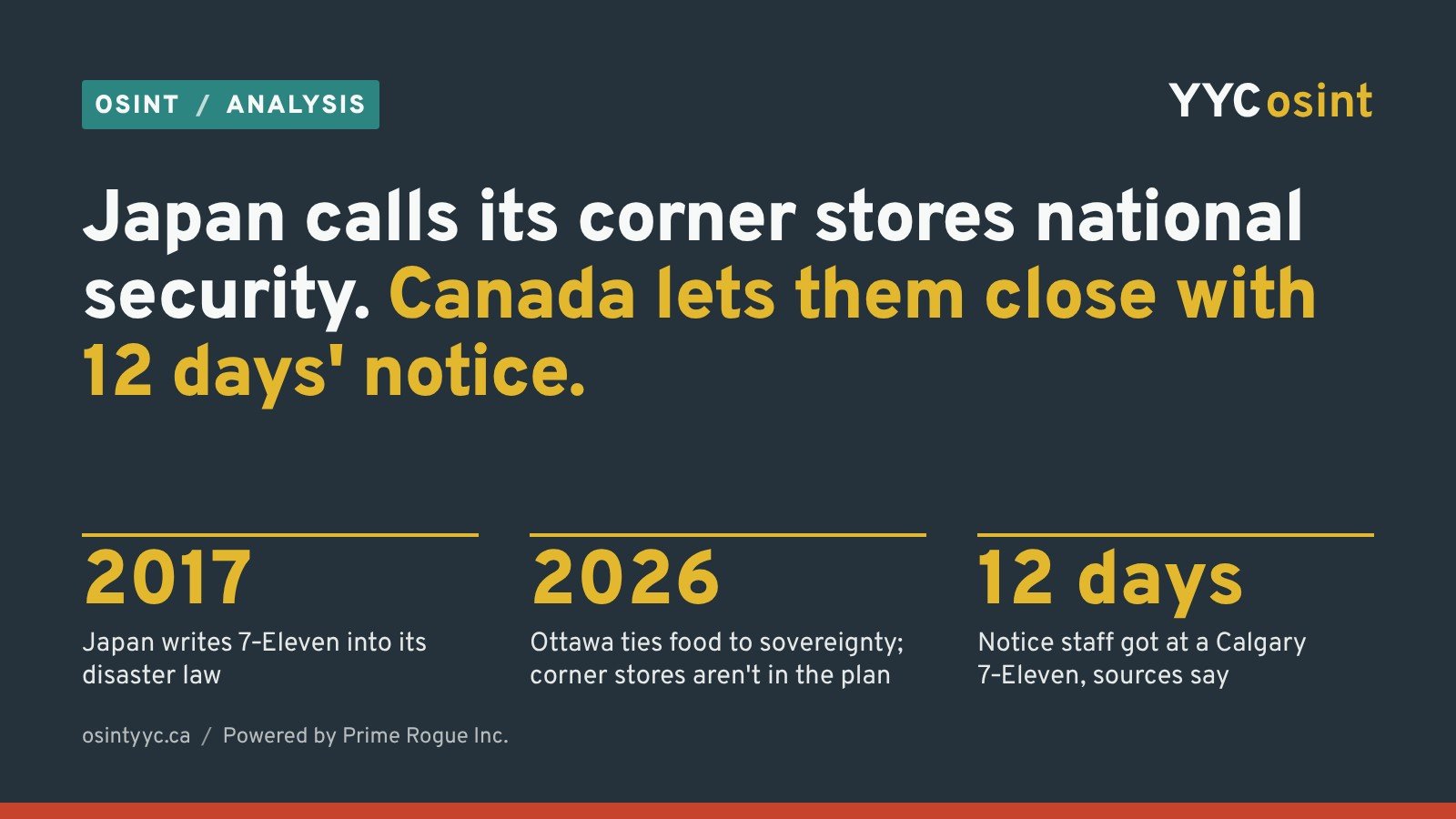
In Japan, a 7-Eleven is part of the country's disaster plan. In Calgary, the one at 2923 26 Ave SW in Killarney is due to close on Friday, Nov. 13. Staff were told 12 days ahead, according to four sources with direct knowledge of the matter, as OSINT YYC reported on Nov. 11.
Both stores belong to the same company. The difference is in how each country thinks about the places where people buy food.
Since 2021, "national security" has been attached to food retail three times: by Japan, to fend off a Canadian bid for 7-Eleven; by France, to stop the same Canadian company from buying a supermarket chain; and by Canada, in a food strategy that ties what's on the shelf to sovereignty. None of the three has anything to say about a store like the one on 26 Avenue SW.
Why Japan treats 7-Eleven as national security
Japan never blocked the takeover of 7-Eleven. It let the words "national security" do the work.
In August 2024, Quebec's Alimentation Couche-Tard, which owns Circle K, offered to buy Seven & i Holdings, 7-Eleven's Japanese parent. Within weeks, Seven & i had asked to be reclassified as "core" under Japan's foreign-investment law, Bloomberg reported, citing unnamed sources. The finance ministry published the new label on Sept. 13, 2024. Seven & i said it was answering a routine survey.
The label changed little in law. "We can't say the core classification makes a buyout more difficult," Finance Minister Shunichi Suzuki said four days later. About a quarter of Japan's listed companies carry it.
The argument behind it is real, though. Since 2017, 7-Eleven Japan has been a "designated public institution" under Japan's disaster law, alongside rivals Lawson and FamilyMart (Nikkei, in Japanese). That status comes with duties: a disaster plan, drills, stockpiles, and deliveries on the government's orders in an emergency. The company says the Kobe earthquake of 1995 and the 2011 tsunami shaped that role.
In January 2025, Economy Minister Ryosei Akazawa said a foreign takeover was "heavily related to (national) security." He asked whether a foreign owner running the chain for profit would give full support to disaster victims (Reuters).
Couche-Tard promised to keep the disaster role. It walked away in July 2025, accusing Seven & i's board of "a calculated campaign of obfuscation and delay." Its letter blamed the board, not the government.
How France blocked Couche-Tard over "food sovereignty"
Couche-Tard had been here before. In January 2021 it approached Carrefour, France's largest supermarket chain. Finance Minister Bruno Le Maire called the grocer an essential link in the country's "food sovereignty" and said France would refuse the deal (RetailDetail). French law lets the government veto foreign purchases in food distribution. The bid was dead within days.
France used a legal veto in the open. Japan used softer signals and never needed its law. In both countries, the government's position was that who owns the food shops is the state's business.
Does Canada treat food stores as national security?
Ottawa already says food is a security matter. It has said so four ways.
- Critical infrastructure. Food has been one of Canada's ten critical infrastructure sectors since 2009, next to energy, finance and water (Public Safety Canada).
- Essential work. In April 2020, federal pandemic guidance listed workers at groceries, pharmacies and other food outlets, "such as convenience and pet food stores," as essential (Public Safety Canada). The guidance was advice, not an order.
- Foreign takeovers. In March 2025, during the tariff war with the United States, Ottawa added "economic security" to the national-security test it applies to foreign investors (Torys).
- Food strategy. On June 11, 2026, Prime Minister Mark Carney launched a National Food Security Strategy worth more than $3 billion. "To protect our sovereignty and take control of our future, we must take control of our food system," he said in his prepared remarks.
The strategy is about supply and competition. Canada imports 88 per cent of its fresh fruit and 72 per cent of its vegetables, and five chains hold about 75 per cent of grocery sales, Global News reported. A $1-billion fund will build food hubs so independent grocers can buy around the big chains. The Competition Bureau gets more money to go after lease terms that stop a rival grocer from opening nearby.
None of that reaches a corner store. The strategy, as reported, doesn't mention convenience stores or neighbourhood access. The investment rules apply only when a foreigner buys a Canadian business. And unlike Japan's disaster law, Canada's critical-infrastructure framework is a voluntary partnership: it puts no duty on a chain to keep a store open, or to tell anyone when it won't.
There is also no sign that Ottawa treats Couche-Tard the way Tokyo treats 7-Eleven. OSINT YYC found no public federal statement backing the company's bid for Seven & i or naming it as strategic.
What it means for Calgary's corner stores
A 7-Eleven is not a supermarket, and nobody should pretend a Slurpee machine is food security. But for people who don't drive, a corner store open all night is where the milk and bread come from.
"This will be very difficult for the older people," Rob, who has lived near the Killarney store for 25 years, told OSINT YYC. "Our regulars who live close by and come in every day."
Calgary has a lot of these stores to lose. The City of Calgary licenses 77 under the 7-Eleven name, which works out to 3.7 times as many per person as Canada overall, according to OSINT YYC's 7-Eleven Watch, which has a page for every store. 7-Eleven's parent plans to close 645 North American stores in the fiscal year ending February 2027 (Retail Insider). It hasn't said how many are in Canada or which ones.
The pattern elsewhere points at the older, standalone stores. In Kelowna, B.C., 7-Eleven Canada said it was closing "non-core assets" (Castanet). After that store shut, the area's five remaining 7-Elevens were all attached to gas stations (KelownaNow). Calgary has 14 other stores like the one in Killarney: no gas licence, licensed since at least 2001, with City business licences that come up for renewal on Dec. 31.
The Killarney store was "doing extremely well," one source said. Staff were told only that it "was not renewed by corporate." No public body was told anything, because none has to be. The City's licence record for the store runs to Dec. 31.
What we don't know
- Does anyone count? OSINT YYC found no federal, provincial or City body that publishes a count of neighbourhood food stores closing. If one exists, we want to see it.
- Will the food strategy reach stores like this? The food hubs are meant for independent grocers. Whether a corner store counts is not clear from what has been published.
- What did Ottawa do when Japan invoked security against a Canadian company? OSINT YYC is preparing access-to-information requests to Global Affairs Canada, Innovation, Science and Economic Development Canada, the Privy Council Office and Finance Canada for their records on the Couche-Tard bid.
OSINT YYC sent 7-Eleven Canada questions about its Calgary stores on Nov. 7. Any response is reported in the Killarney story.
Quick answers
Why is 7-Eleven treated as national security in Japan?
Convenience stores are part of Japan's disaster response. 7-Eleven Japan has been a designated public institution under Japan's Disaster Countermeasures Basic Act since 2017. In January 2025, Economy Minister Ryosei Akazawa tied a foreign takeover of its parent company to national security.
Did Japan block Couche-Tard's takeover of 7-Eleven?
No. Alimentation Couche-Tard withdrew its offer for Seven & i Holdings on July 16, 2025, and blamed the company's board. Japan never opened a formal review of the deal.
Does Canada treat grocery or convenience stores as national security?
In words, partly. Food is one of Canada's ten critical infrastructure sectors, and the National Food Security Strategy of June 2026 ties food to sovereignty. No federal rule protects an individual store or requires notice when one closes. Canada's foreign-investment review applies only when a foreign buyer takes over a Canadian business.
Which Calgary 7-Elevens are closing?
One closing is confirmed by sources: the store at 2923 26 Ave SW in Killarney, due to close on Nov. 13, 2026. 7-Eleven has not named any others. OSINT YYC tracks every Calgary store on 7-Eleven Watch.
Related from OSINT YYC
- Killarney's 26th Avenue 7-Eleven closes Friday
- Calgary 7-Eleven Watch: every store, City licence and map change
- The 7-Eleven at 2923 26 Ave SW: licence record and satellite view
- Killarney/Glengarry on OSINT YYC
- City of Calgary permits, pulled daily
Disclosure
The author worked for Couche-Tard in Montreal as a CEGEP and university student, from about 2003 to 2005. He lives in Killarney, is a regular customer of the 7-Eleven on 26 Avenue SW and knows its staff.