DevelopingStories OSINT YYC
The Snowbirds' last public flight is over Calgary tonight. It is not their last flight
Nine CT-114 Tutors pass over McMahon Stadium at about 5 p.m. Alberta Time for the 113th Grey Cup — the final scheduled public appearance of a jet the government paid $30 million to keep flying until 2030.

By Kevin J.S. Duska Jr.Published

Developing, published 4:55 p.m. Alberta Time, Sunday, Nov. 15 (5:55 p.m. EST / 22:55 UTC), before the flypast: this page will be updated after the pass with what flew, from which direction, and how many aircraft. The route and the aircraft count below are reported, not confirmed.
Nine red-and-white jets will cross over McMahon Stadium at about 5 p.m. Alberta Time (6 p.m. EST / 23:00 UTC) tonight, timed to the last note of the national anthem. Most of the coverage is calling it the Snowbirds' last flight. It isn't, and the distinction matters for anyone planning to stand on a hill in the cold to watch it.
It is the last scheduled public flight of the CT-114 Tutor. The airframes will fly again — on Monday, and after that, one last time.
What happens tonight
The flypast is part of the 113th Grey Cup, the Montreal Alouettes against the Edmonton Elks at McMahon Stadium. Sarah McLachlan sings the anthem, and the jets are timed to arrive as she finishes.
The mechanics, per The Canadian Press: the aircraft depart Calgary International, pass over the stadium as low as roughly 150 metres, then return to the airport, while the squadron buses back in to watch the rest of the game from the stands.
The Weather Network has flagged Mackowecki Hill, Nose Hill and the SAIT/Jubilee Auditorium parkade as the vantage points outside the stadium. Mackowecki Hill overlooks both McMahon and downtown. Nose Hill's south-facing ridges are the highest ground and have the most room.
One caution on the route. Several outlets report the formation running south to north over the stadium. OSINT YYC could not find that confirmed by the RCAF or in a published NOTAM, and one widely shared version of the claim traces back to an AI-generated answer on X rather than to the Air Force. Treat the direction as reported, not established. The RCAF's own 2026 Snowbirds schedule does not publish a run-in heading.
For photographers: at 5 p.m. the sun sits about 5 degrees above the horizon at azimuth 231 — low in the west-southwest — and sets at 5:48. Facing north gives you lit airframes. Facing south gives you glare and rim light. Available light drops roughly a stop every fifteen minutes.
If you are watching from Killarney
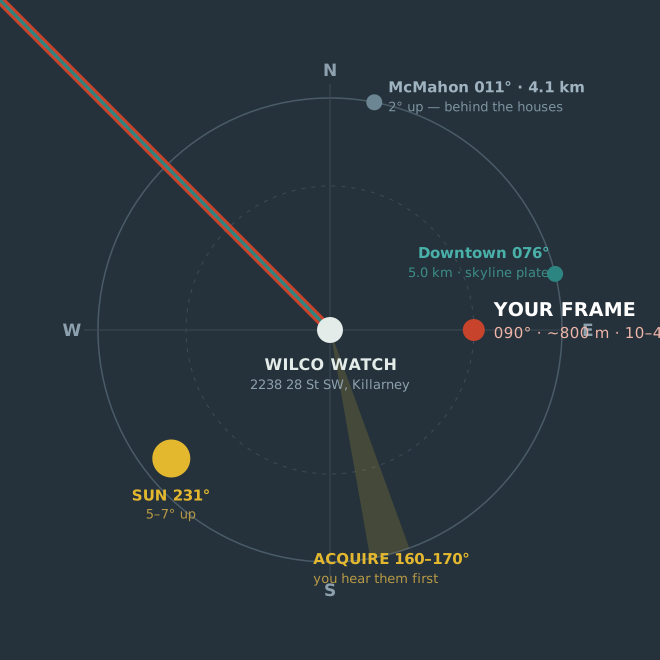
Face east, not north. From the 2200 block of 28 Street SW, McMahon Stadium bears 011 degrees at 4.1 km — about 2 degrees above the horizon, behind houses and trees. The stadium pass is not obtainable from a residential street.
The usable frame is due east, 090 degrees, roughly 800 m out, while the formation is still inbound — so look 10 to 40 degrees up, well above the 150-metre minimum it holds over the stadium. Downtown bears 076 degrees at 5.0 km, so the skyline is your landmark: the aircraft pass just to the right of it.
Acquire to the south and south-southeast, 160 to 170 degrees. You will hear them before you see them. With the sun at 231 degrees and 5 to 7 degrees above the horizon, facing east puts it behind your shoulder and the airframes fully front-lit against a darker eastern sky.
How they got here
The Tutor is older than most of the people watching it tonight. The Canadian Armed Forces ordered the type as a training aircraft in 1961, it entered RCAF service in 1963, and it has been the Snowbirds' aircraft since the team formed in 1971 — the only jet the team has ever flown. Across 55 seasons the Snowbirds have performed roughly 2,700 times in front of more than 140 million people (CBC Calgary).
On May 19, 2026, Defence Minister David McGuinty announced at 15 Wing Moose Jaw that 2026 would be the Tutor's final air show season (Global News). The replacement is the CT-157 Siskin II, a Pilatus turboprop, which will be based at Moose Jaw and used for training as well as demonstration flying (Skies Magazine). It is not expected before the early 2030s.
That gap is the part worth sitting with. The team stands down after tonight and is expected to be grounded until roughly the early 2030s — a hiatus the Snowbirds' own commanding officer has described as five years.
The $30 million question
Here is what has not been widely reported alongside the farewell coverage.
In 2021, Ottawa signed a $30-million contract intended to keep the Tutor fleet in commission until 2030. Tonight the fleet retires four years short of that, and the aircraft meant to replace it will not arrive until the early 2030s at the earliest.
So the public is being asked to absorb two things at once: a life-extension program that did not deliver the life it extended toward, and a capability gap of roughly five years in which Canada has no aerial demonstration team at all. Neither the May announcement nor tonight's coverage has explained what the $30 million bought, why the 2030 target was abandoned early, or what the Siskin II acquisition will ultimately cost. RCAF commander LGen Jamie Speiser-Blanchet said in May that the decision to retire the Tutor "was not taken lightly."
OSINT YYC has filed to find out. We will publish the response.
Where the jets actually go
The fleet does not stop flying tonight.
After the game the squadron returns to Saskatchewan on Monday. Capt. Marc-André Plante — Snowbird 8 — told The Canadian Press that if there is fuel enough, they will likely pass over their home city of Moose Jaw on the way in. That is Plante's expectation, not a published plan: 15 Wing Moose Jaw has not confirmed a flyover, and OSINT YYC has not found one on the RCAF's schedule. The team's Regina flyover had already been rescheduled to Monday, CJME reported last week.
Snowbirds commanding officer Lt.-Col. Guillaume Paquet has said the fleet will then be flown to Ontario — to CFB Trenton, home of 8 Wing — to be retired.
After that they are done. Paquet said the planes will no longer be flyable, though some may be kept as maintenance training aids. Others go to museums and onto display pedestals, with the contractor handling the fleet's disposal fielding requests from anyone who wants one (CKOM).
So: tonight is the last time the public is invited. Monday is the last time they fly as a team. Trenton is the end.
What we could not confirm
In keeping with how OSINT YYC works, here is what is reported but unverified as of publication:
- The south-to-north approach. Reported by multiple outlets, unconfirmed by the RCAF or any NOTAM we could locate. One version of the claim traces to an AI-generated answer on X.
- Monday's Moose Jaw flyover. Capt. Marc-André Plante told The Canadian Press the formation would likely pass over Moose Jaw if fuel allowed. That is what he said, not a confirmed plan. 15 Wing has not confirmed it and it is not on the published schedule.
- Mackowecki Hill's exact location. Named by The Weather Network and others as the best vantage point; we could not independently establish its boundaries or access.
- Whether all nine aircraft fly. Nine is the plan. Serviceability on a 63-year-old fleet is not guaranteed.
- The exact retirement date. Reports say "end of the year"; one aviation outlet, AVweb, puts the formal retirement in 2027. We have not found the authoritative date.
- Who handles the fleet's disposal. Reporting describes a contractor fielding requests for retired airframes. OSINT YYC has not confirmed which company holds that work or where it is done.
Sun position and times in this piece were calculated for McMahon Stadium's coordinates rather than taken from a published source.
Quick answers
What time do the Snowbirds fly over McMahon Stadium?
The flypast is scheduled for about 5 p.m. Alberta Time (6 p.m. EST / 23:00 UTC) on Sunday, Nov. 15, 2026, timed to the last note of the national anthem at the 113th Grey Cup. Nine CT-114 Tutors are planned, passing as low as roughly 150 metres.
Is this the Snowbirds' last flight ever?
No. It is the last scheduled public flight of the CT-114 Tutor. The squadron flies back to Saskatchewan on Monday, Nov. 16, and the fleet is then to be flown to CFB Trenton (8 Wing) in Ontario to be retired.
Where can I watch the Snowbirds flypast in Calgary?
The Weather Network has flagged Mackowecki Hill, Nose Hill Park and the SAIT/Jubilee Auditorium parkade as the vantage points outside the stadium. Mackowecki Hill overlooks both McMahon Stadium and downtown. Nose Hill's south-facing ridges are the highest ground and have the most room.
What is replacing the CT-114 Tutor?
The CT-157 Siskin II, a Pilatus turboprop, which will be based at 15 Wing Moose Jaw and used for training as well as demonstration flying. It is not expected before the early 2030s, leaving a gap the Snowbirds' commanding officer has described as five years.
How much did Canada spend to keep the Tutor flying?
Ottawa signed a $30-million contract in 2021 intended to keep the Tutor fleet in commission until 2030. The fleet retires four years short of that, and its replacement is not expected until the early 2030s at the earliest.
Related from OSINT YYC
- Every OSINT YYC story, newest first
- What time is it in Calgary? Alberta Time, UTC−6, year-round
- FAA ground stop halts every Calgary flight to the U.S.
- Killarney/Glengarry on OSINT YYC
- More reporting by Kevin J.S. Duska Jr.
Sources
- The Canadian Press, via CKOM, Snowbirds to perform farewell flypast at Grey Cup game
- CJME, Snowbirds reschedule Regina flyover for Monday
- CKOM, Snowbirds Tutor jets will be displayed, used for training after retirement
- CBC Calgary, Coverage of the Snowbirds' final flight in Calgary
- Skies Magazine, The iconic name remains, but Tutor jets to be replaced by turboprops
- Global News, Defence minister on the Canadian Snowbirds
- The Weather Network, Four places to wave goodbye to the Snowbirds this weekend in Calgary
- Royal Canadian Air Force, 2026 Snowbirds schedule
- AVweb, on a formal retirement in 2027. No link: OSINT YYC has not matched the claim to a specific published item.
This story was published at 4:55 p.m. Alberta Time on Nov. 15, 2026, before the flypast, and will be updated after the pass. Tips: press@primerogueinc.com.